カテゴリー: 未分類

  • Visual Novel Lessons : A New Approach To Building Educational Infrastructure

    Introduction

    Novelitas is a project to establish a visual novel lesson platform.

    We propose visual novel lessons as a new approach to build educational infrastructure.

    Current Approaches

    There have been two types of approaches in building educational infrastructure. Let’s take a closer look.

    1.The Physical Approach

    The first is the physical approach such as building schools.

    It is the most common and ideal way, but it costs a lot in many ways. Our resources are limited, so this approach has some limitation also.

    2.The Technological Approach

    As a supplemental way, lectures using internet may have helped reducing educational gaps in the world. This is what we call the technological approach.

    This approach can be divided further into two ways: online real-time lectures and on-demand video lectures.

    Real-time lectures using video conference systems require strong internet infrastructure. They can cause latency issues even in developed countries.

    Video lectures, although more flexible, are relatively heavy in data size and require stable internet connectivity, such as Wi-Fi.

    So, what is the solution?

    Education should be delivered to everyone in the world equally. From this perspective, two points are important: accessibility and inclusivity.

    Accessibility means ensuring that anyone can access the content. On the internet, this requires keeping the content lightweight.

    Inclusivity means ensuring that no one is left behind. Online and on-demand lectures often lack fully functional subtitle systems, which can prevent certain learners – such as those with hearing impairments – from benefiting fully.

    A new approach: creating HTML5 lessons

    One possible approach to contain these two aspects is creating lectures in HTML.

    HTML, mainly used in creating websites, can write lightweight on-demand content if designed efficiently.

    If combined with Java Script, it is possible to make interactive lesson content run in the browser like browser-based games.

    The concept of Visual Novel Lessons

    To reproduce the UI of real lessons in HTML, one possible model is lessons in visual novel format.

    Visual Novels are type of game in which players read narration and dialogue, typically composed of background images, text box, and buttons.

    By representing the background as a whiteboard and displaying the instructor’s speech in text box with a typewriter animation, the UI of real lessons – particularly video lectures – can be reasonably reproduced.

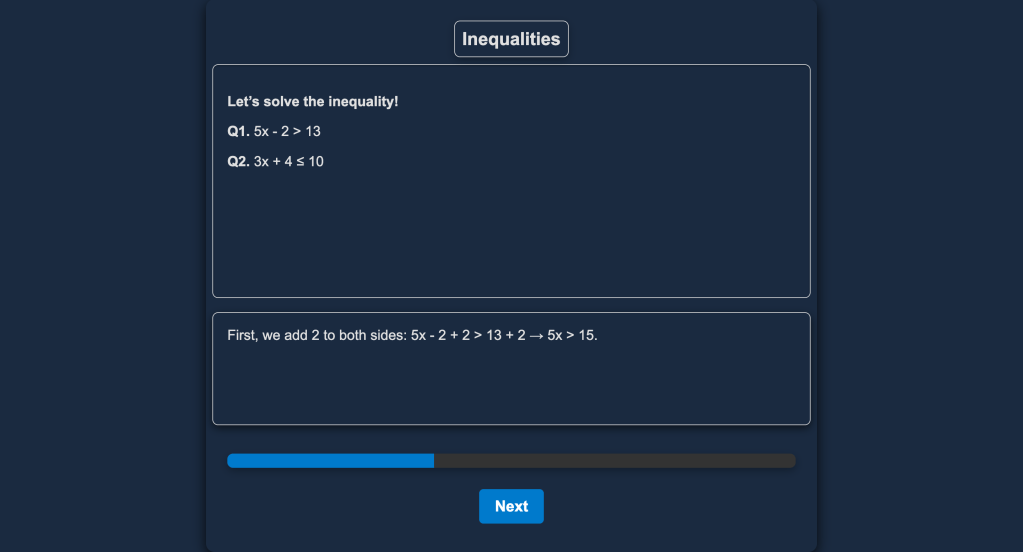
    We call the lessons created in this format Visual Novel Lessons. Below is the model developed in this project.

    Latest model. This model was developed in the assistance with ChatGPT.

    By not using background images, we achieve lightweight lessons.

    According to hosting information, a typical five-minute lesson in this model is about 15KB, and even longer lessons generally stay under 20KB. This is extremely lightweight compared to videos (which are often several tens of MB).

    Simple charts and graphs can be drawn as SVGs within the lesson interface to maintain this lightweight design.

    Although the customizations of backgrounds is lower than video lessons, this trade-off allows for interactivity through HTML and Java Script – such as buttons and quizzes – which video lessons cannot easily provide.

    Also created in the assistance with ChatGPT.

    Platformization

    If a platform can be built that has these lightweight visual novel lessons, I believe it is possible to create a form of educational infrastructure.

    As of January 5, 2026, the project has released about 150 lessons, with additional content in stock. By continuing to expand the collection, we believe it is possible to build a platform that covers learning content from basic topics up to university entrance exam level.

    Conclusion

    Building an educational infrastructure is a long journey that requires the participation of many people.

    I wanted to propose visual novel lessons as a potential solution as a possible way to contribute to building such infrastructure.

    Thank you for reading.

    *I translated this article from Japanese to English in the assistance with ChatGPT.

  • History – The Fall of The Roman Empire

    The Fall of The Roman Empire

    Welcome! In this lesson, we will learn about the fall of the Roman Empire.


    Summary

    Constantine: moved the capital from Rome to Byzantium, renaming it Constantinople.

    395 CE: The Roman Empire was officially divided into Western and Eastern Empires.

    Western Empire became increasingly weak due to political instability, economic problems, and military challenges.

    Foreign Invasions: Germanic tribes attacked Roman borders.

    Eastern Empire (Byzantine): Continued to exist.

  • History – The Roman Empire

    The Roman Empire

    Welcome! In this lesson, we will learn about Roman Empire.


    Summary

    The Roman Republic

    – Citizens, non-citizens, slaves (citizens could vote, others had limited rights)

    – Julius Caesar: key figure in transition to Empire

    The Roman Empire

    – Augustus: first Emperor, stabilized empire

    Governance

    – Emperor had ultimate authority

    – Roman law and infrastructure unified the empire

    Society and Culture

    – Social classes remained: citizens, non-citizens, slaves

    – Greek cultural influence

  • History – Origins of Christianity

    Origins of Christianity

    Welcome! In this lesson, we will learn about the origins of Christianity.


    Summary

    Background

    – Judea under Roman rule

    – Hope for a Messiah

    Jesus of Nazareth

    – Love, forgiveness and faith in God

    Departure

    – Jesus departed from this world

    – Seen as a political threat by Roman and Jewish leaders

    – It is said he rose from the dead

    Spread

    – Disciples, including Paul, spread teachings

    – Writings later became the New Testament

    Roman Empire

    – 4th century: Constantine legalized Christianity

    – Later: became official religion of the Roman Empire

  • History – Ancient Greece and Ancient Rome

    Ancient Greece and Ancient Rome

    Welcome! In this lesson, we will learn about ancient Greece and ancient Rome.


    Summary

    Ancient Greece

    – City-states (polis), e.g., Athens and Sparta

    – Athens: democracy, arts, philosophy

    – Sparta: military training and discipline

    – Olympic Games, contributions to science and mathematics

    Ancient Rome

    – Began on Tiber River, grew into a large empire

    – Republic → Empire ruled by emperors

    – Engineering: roads, aqueducts, Colosseum

    – Roman law, Latin language, cultural influence

    Comparison

    – Both contributed to politics, culture, and technology

    – Greece: independent city-states; Rome: unified empire

    – Greece: philosophy, arts, democracy; Rome: engineering, law, governance

  • History – Ancient Asia

    Ancient Asia

    Welcome! In this lesson, we will see two important civilizations in ancient Asia.


    Summary

    Indus Valley Civilization

    – Location: Indus River

    – Well-planned cities with straight streets and drainage systems

    – Skilled in farming, trade, and crafts

    – Writing system not fully understood

    Yellow River Civilization

    – Location: Yellow River (Huang He)

    – Fertile soil, but floods were dangerous

    – Dynasties passed power through families

    – Developed ancestor worship and harmony with nature

    Comparison

    – Both developed near rivers

    – Both relied on farming

    – Indus: carefully planned cities

    – Yellow River: dynasties and traditions

  • History – Mesopotamia and Ancient Egypt

    Mesopotamia and Ancient Egypt

    Welcome! In this lesson, we will learn about Mesopotamia and ancient Egypt.


    Summary

    Mesopotamia

    – Location: Between Tigris and Euphrates rivers

    – Farming enabled city growth

    – Writing: Cuneiform

    – Structures: Ziggurats (temples)

    – Civilizations: Sumerians, Akkadians, Babylonians, Assyrians

    Ancient Egypt

    – Location: Nile River

    – Annual Nile floods → fertile soil

    – Writing: Hieroglyphics

    – Structures: Pyramids (tombs for pharaohs)

    – Society: Ruled by pharaohs, strong belief in gods and afterlife

    Comparison

    – Both depended on rivers for farming

    – Both developed writing systems and built impressive structures

    – Mesopotamia: city-states; Egypt: centralized under pharaohs

  • Math – Decimals3

    Multiplying and Dividing Decimals

    Welcome! In this lesson, we will learn how to multiply and divide decimals.


    Summary

    Multiplying Decimals

    Step 1: Ignore decimal points and multiply as whole numbers

    Step 2: Count total decimal places in both numbers

    Step 3: Place decimal in product

    Example 1

    0.4 × 0.3 → 4 × 3 = 12 → 0.12

    Example 2

    1.2 × 0.5 → 12 × 5 = 60 → 0.6

    Dividing Decimals

    Step 1: Move decimal in divisor to make it whole number

    Step 2: Move decimal in dividend the same number of places

    Step 3: Divide as usual

    Example 3

    0.6 ÷ 0.2 → 6 ÷ 2 = 3

    Example 4

    1.5 ÷ 0.25 → 150 ÷ 25 = 6

  • Math – Fractions and Decimals

    Fractions and Decimals

    Welcome! In this lesson, we will learn how to convert fractions to decimals and decimals to fractions.


    Summary

    Fractions to Decimals

    a/b → divide a ÷ b

    Example 1

    2/5 → 2 ÷ 5 = 0.4

    Example 2

    7/8 → 7 ÷ 8 = 0.875

    Decimals to Fractions

    Write decimal as fraction with denominator 10, 100, 1000…, then simplify

    Example 3

    0.75 → 75/100 → 3/4

    Example 4

    0.6 → 6/10 → 3/5

  • Math – Fractions5

    Dividing Fractions

    Welcome! In this lesson, we will learn how to divide fractions.


    Summary

    Dividing Fractions

    a/b ÷ c/d = a/b × d/c

    Example 1

    3/4 ÷ 2/5 = 3/4 × 5/2

    Example 2

    1 1/2 ÷ 3/4 = 3/2 × 4/3